
ceramics
Experimental Bonfirings of Pottery with Camel Dung Fuel, Jordan, July 2018

Publication Date
The objective of this series of experimental pottery firings with camel dung fuel was to isolate the function of this fuel type within the context of a simple mode of pottery firing for data applicable to studies of ancient pottery manufacture...
A Preliminary Attempt to Reconstruct some Tools and Techniques of Ornamentation of the Comb-Pit Ware from the Site of Hepojarvi (Karelian Isthmus, Leningrad Oblast, Russia)

Publication Date
The site of Hepojarvi is located on the northern coast of Hepojarvi lake, near Saint Petersburg, Russia. The site is a multi-layer settlement with different types of Neolithic pottery (from Sperrings to late Comb-Pit Ware); the settlement functioned in 5314 cal BC – 2342 cal BC. It was excavated in 1978 by I. V. Vereschagina.
CRAFTER: An Experimental Approach to Fire-Induced Alteration of Pottery Fabrics
Publication Date
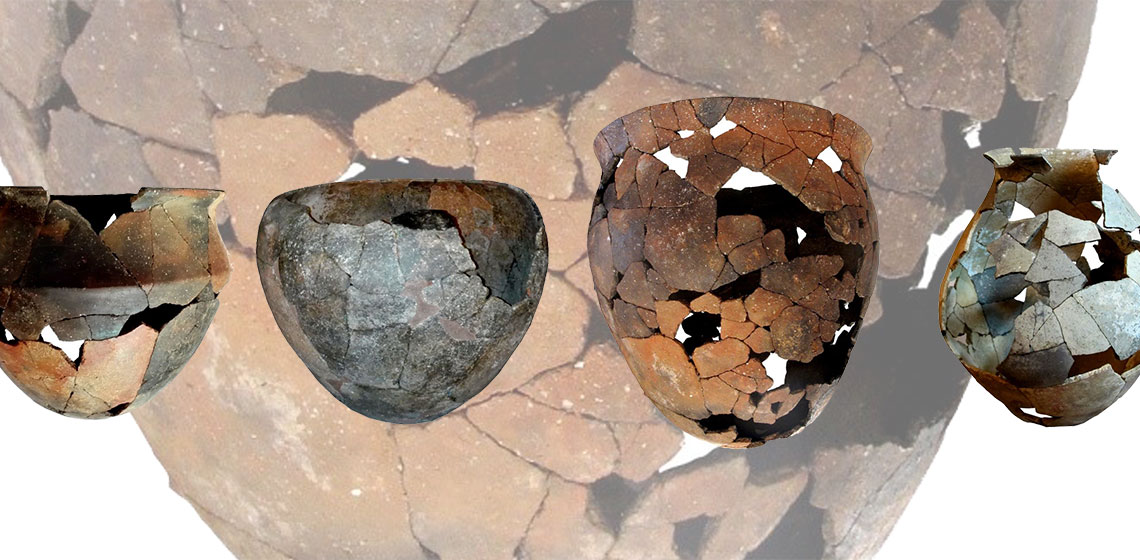
In doing an inventory of ceramic materials from archaeological excavations, it is a common practice to indicate their observable atmosphere of firing. This parameter refers to the presence of gases, especially oxygen, during the firing and cooling of pottery: if oxygen circulates freely, the procedure is said to be oxidising; if, on the contrary, the atmosphere of firing lacks free air, it is called reducing...
CRAFTER: Re-creating Vatin Pottery 2: an Examination of Clay Quality and its Behaviour

Publication Date
The Bronze Age Vatin culture has been known in archaeology as a cultural phenomenon distinguished by a specific material culture which existed between c. 2200 to 1600 B.C. in the region of the southern part of the Pannonian Plain, and the area along the lower Sava river and south of the Danube river. The Vatin culture followed on from the Early Bronze Age cultures in the region, indicating stabilization in this area after the disintegration of the Aeneolithic Vučedol culture by tribes from the Russian steppe (Garašanin 1979, p. 504; cf.
Event Review: CRAFTER: Back to Bronze Age Craftsmanship: International Meeting of Potters and Archaeologists

Publication Date
At the end of October 2018, nearly 30 experts – potters and archaeologists – met in the city of Mula (Murcia, Spain) to study Europe’s Bronze Age pottery-making techniques. The event was the initiation stage of the CRAFTER project (Crafting Europe in the Bronze Age and Today), implemented in the framework of the European Year of Cultural Heritage 2018 and the Creative Europe Program...
CRAFTER: Potting Techniques of the Bronze Age

Publication Date
Throughout its history, experimental archaeology has fulfilled a valuable role in archaeological research, allowing craftspeople and scholars alike to deepen an understanding of people and their societies in the past. EXARC’s recent involvement in the CRAFTER project, and the author’s participation in its International Meeting in Mula (Spain), has demonstrated that significant knowledge gaps remain in...
Event Review: The Second Annual Vounous Terracotta Symposium

Publication Date
Rauf Ersenal has hiked through the mountains of North Cyprus for years, searching for the rare clays that have been used to make pottery there for millennia. The most prized colours of these clays produce a soft green that is the colour of fresh olives, the bright red of terra sigiliata, and another clay that creates a true black...
CRAFTER: Re-creating Vatin Pottery

Publication Date
An attempt to re-create pottery of the Vatin culture has been made within the Crafter project (Crafting Europe in the Bronze Age and Today), whose aim is to help revive modern-day artisanship by drawing inspiration from Bronze Age pottery of four European Bronze Age societies: El Argar (Spain), Únětice (Central Europe), Füzesabony (eastern Hungary) and Vatin (Serbia)...
Scientific Profit through Daily Routine

Publication Date
10th EAC Leiden 2017
***The open-air museum Campus Galli is a construction site where we built an early medieval monastery, following the so-called “Plan of St. Gall”, an architectural drawing from the first half of the 9th century (Carolingian period) as our major reference source (cf. Schedl, 2014; Facsimile: Tremp, 2014)...
***The open-air museum Campus Galli is a construction site where we built an early medieval monastery, following the so-called “Plan of St. Gall”, an architectural drawing from the first half of the 9th century (Carolingian period) as our major reference source (cf. Schedl, 2014; Facsimile: Tremp, 2014)...
CRAFTER: Reviving Bronze Age Pottery in EU-funded Project

Publication Date
The CRAFTER project aims at reviving modern-day artisanship by drawing inspiration from pottery traditions of four of the most remarkable Bronze Age societies of Europe: El Argar (south-eastern Spain), Únětice (Central Europe), Füzesabony (eastern Hungary) and Vatin (south Serbia)...